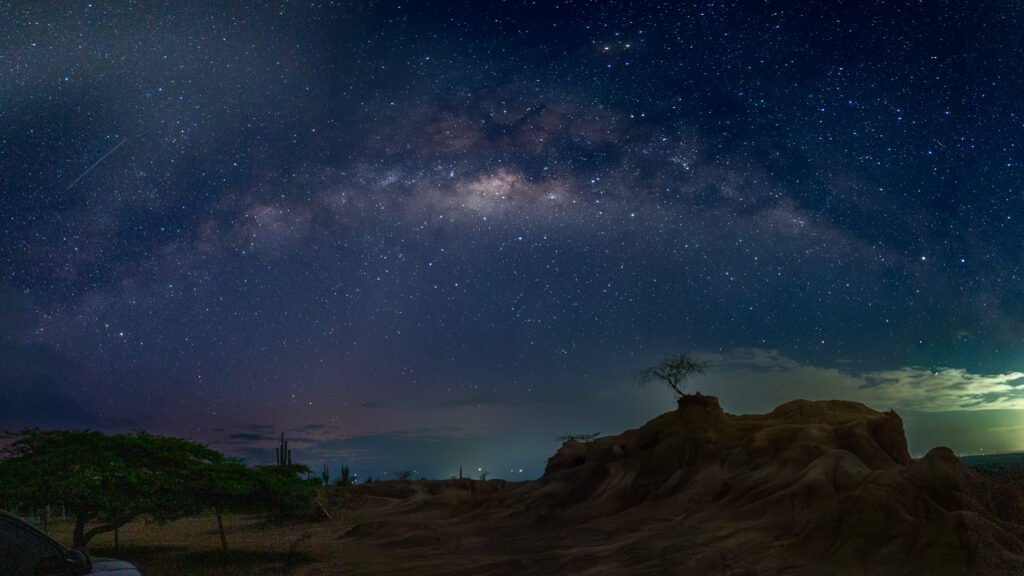
The Tatacoa Desert is a place where the earth’s red clay meets the heavens’ silver dust. This past February, I set out on a mission to document the first “Prime” window of the 2026 Galactic Core season. The result is a collection of Panoramas & timelapses that capture the profound stillness of the Colombian dry forest.
The Master Gallery: Moments of Celestial Bliss Each of these images was captured during the “Astronomical Dark” window between 1:30 AM and 4:45 AM, utilizing the dual-rig setup of the Canon 6D and Canon T3i – both coupled with Rokinon 14mm f/2.8 lenses.
The Desert’s Breath: Tatacoa Night Lapse In the heart of Colombia’s Red Desert, the sky is rarely ever truly still. This timelapse captures a rare, moody dance between the elements. While astrophotographers often chase perfectly clear nights, there is a unique magic in the way the clouds interact with the galactic core, adding a sense of scale and “breath” to the vastness of space.
Notice how the Milky Way glows with intense golden and colorful hues even through the passing clouds. This is a testament to the true dark skies of the Tatacoa region and the high dynamic range of the 6D sensor. If you observe closely, you will see lightning show up in some of the timelapses at the bottom left corner.
For best results, watch these in full screen mode
Metadata: 📍 Loc: Red Desert (Cuzco) / 📸 Gear: Canon T3i + Rokinon 14mm ⚙️ Settings: f/2.8, 400-700 20s exposures stitched into a timelapse, ISO 3200
As the clouds roll by, you can see the distant glow on the horizon—a reminder of the thin line between the remote wilderness and the encroaching light of civilization. For those living the nomad’s life, these moments of solitude under a shifting sky are what we live for. It isn’t just about the “perfect shot”; it’s about witnessing the Earth and the Galaxy in constant, beautiful motion.
1. The Rising Arch (Red Desert)
By capturing the core at exactly 4:00 AM, I was able to align the galactic center with this specific notch in the red clay hills. This is a mosaic of 12 shots combined into a single panorama, processed to maintain the natural tones of the desert floor, while highlighting the Red desert and its hues at night.
Metadata: 📍 Loc: Red Desert (Cuzco) / 📸 Gear: Canon 6D + Rokinon 14mm⚙️ Settings: f/2.8, 12 x 20s, ISO 3200
2. The Core
Shot at around 3:30am, the central, brightest region of the image is the Galactic Bulge. This area is packed with ancient stars and high-density interstellar gas, creating that characteristic golden-white glow. The dark, vein-like structures cutting through the starlight are massive clouds of interstellar dust. These comprise the Great Rift, which is opaque to visible light and obscures the actual center of the galaxy. Visible within the frame are various HII regions (pinkish nebulosity) where new stars are being born, alongside scattered open clusters that appear as dense “diamond dust” against the dark sky background.
Metadata: 📍 Loc: Red Desert (Cuzco) / 📸 Gear: Canon 6D + Rokinon 14mm ⚙️ Settings: f/2.8, Single 20s shot, ISO 3200
3. The 12-Frame Zenith: A Galactic Panorama
Capturing the scale of the cosmos requires more than a single shutter click. This image is a high-resolution 12-frame mosaic, meticulously stitched to recreate the immersive experience of standing under a truly dark sky. By opting for a multi-panel panorama, I was able to move beyond the limitations of a single wide-angle frame to produce a celestial map with incredible depth and clarity. Instead of one 14mm shot—which often suffers from edge distortion—I captured 12 landscape frames with around 60% overlap using the Syrp Genie II Pan/Tilt head. This technique allowed me to use the sharpest center-point of the lens for every “slice” of the sky, resulting in a panorama that is tack-sharp from the desert floor to the top of the galactic arch.
Metadata: 📍 Loc: Red Desert (Cuzco) / 📸 Gear: Canon 6D + Rokinon 14mm ⚙️ Settings: f/2.8, 12 x 20s landscape shots, ISO 3200
4. The Nomad’s Sentinel: Serendipity in the Red Desert
Sometimes, the best compositional elements aren’t planned; they simply arrive. While planning my session in the heart of the Red Desert, a fellow group of travelers pulled up in their rugged, rustic van to set up camp for the night.
In the world of astrophotography, unexpected visitors can often be seen as a challenge to a clean frame. But as I watched their van settle against the horizon, I realized it was the perfect foreground anchor for the 12-frame panorama I was capturing. It transformed a beautiful landscape into a lived-in story—a true “Nomad’s Life” under the celestial river. By integrating the van into the silhouette, I was able to give the image a sense of scale. The Canon 6D and Rokinon 14mm captured the fine edges of the vehicle, contrasting the mechanical traveler with the ancient light of the galactic core. It serves as a reminder that we aren’t just observers of the stars; we are part of the landscape. Two different groups, drawn to the same remote coordinates by the same prehistoric light.
Metadata: 📍 Loc: Red Desert (Cuzco) / 📸 Gear: Canon 6D + Rokinon 14mm ⚙️ Settings: f/2.8, 12 x 20s landscape shots, ISO 3200
Metadata: 📍 Loc: Red Desert (Cuzco) / 📸 Gear: Canon 6D + Rokinon 14mm ⚙️ Settings: f/2.8, 12 x 20s landscape shots, ISO 3200
Metadata: 📍 Loc: Red Desert (Cuzco) / 📸 Gear: Canon 6D + Rokinon 14mm ⚙️ Settings: f/2.8, 12 x 20s landscape shots, ISO 3200
Metadata: 📍 Loc: Red Desert (Cuzco) / 📸 Gear: Canon 6D + Rokinon 14mm ⚙️ Settings: f/2.8, 4 x 20s landscape shots, ISO 3200
4 thoughts on “Chasing the Core: A Celestial Odyssey in the Tatacoa Desert”
BG AWS
Absolutely brilliant images and videos Shailesh. Beautifully captured nature in all its resplendence!


Absolutely brilliant images and videos Shailesh. Beautifully captured nature in all its resplendence!
WOW!! Incredible!!!
Thank you for sharing!!
Wow! Incredibly beautiful captures. Thank you for sharing Shailesh!
This is incredible Shailesh. Beautiful captures and amazing notes about each one of it. Thanks for sharing.